
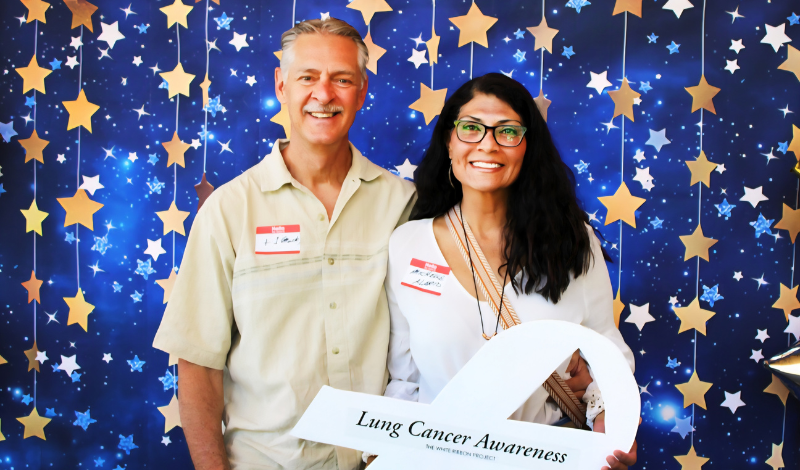
Michelle Alarid was healthy, active, and 45 years old when a single emergency room visit changed the course of her life. A U.S. Army National Guard Veteran who had served during Desert Storm, she had no reason to think lung cancer was coming. But her story would become one of the most important lessons in Veteran lung cancer and biomarker testing—a lesson learned the hard way, and one she now shares so others don’t have to.
A Diagnosis No One Expected
In November 2015, just days before her birthday, Michelle went to the emergency room with severe pain in her lower right back and an overwhelming sense that something was very wrong. She expected to be told it was minor. Instead, a CT scan revealed a mass in her right upper lung. The diagnosis was delivered without sugarcoating: it was lung cancer.
Strangely, the pain that brought her to the ER never returned. Doctors were never able to explain it. Michelle believes it saved her life.
She was diagnosed with stage I non-small cell lung cancer (NSCLC). Even her oncologist initially doubted the diagnosis—she was young, fit, and healthy by every measure. A biopsy confirmed it. In December 2015, just before Christmas, Michelle underwent minimally invasive VATS surgery—a procedure that uses small incisions and a tiny camera to remove part of the lung—to remove one lobe of her right lung.
Her recovery exceeded every expectation. Thirty days later, she was skiing. Shortly after, she was back at work. For more than two years, her scans showed no evidence of disease.
When Lung Cancer Returned
In 2017, subtle but persistent symptoms began to surface—sinus problems, changes in taste, difficulty sleeping, headaches, and cognitive and vision issues. Michelle was working as a case manager in a federal prison. It was easy to attribute the changes to stress or a demanding job. She reported the symptoms to her oncologist, but her brain was not being routinely scanned.
In January 2018, a nurse practitioner listened closely and ordered a brain MRI. The scan revealed two brain metastases—areas where the lung cancer had spread to her brain.
That moment marked a turning point in Michelle’s journey.
Biomarker Testing Changed Everything
After her cancer spread to her brain, biomarker testing was finally performed. Biomarker testing identifies specific changes in a tumor’s genetic makeup that can point to targeted treatment options. Michelle learned her cancer carried an EGFR mutation—a change that made her eligible for a therapy designed specifically to target it.
She underwent stereotactic radiosurgery (SRS)—a precise, non-invasive radiation treatment—to address the brain tumors and began targeted therapy. Her initial medication caused severe side effects. But shortly after, a new drug was approved as a first-line treatment for EGFR-positive lung cancer, and Michelle was able to switch.
She has remained on that medication, with few issues, ever since.
Over time, the brain tumors shrank and eventually disappeared. Today, Michelle’s scans show no evidence of disease. She continues to be closely monitored, always aware that recurrence is possible—and deeply grateful for the advances in treatment that have extended her life.
Service, Exposure, and the Fight for Recognition
Michelle served in the U.S. Army during Desert Storm, where she was exposed to burning oil fields and toxic air. She strongly believes that exposure caused her lung cancer. After years of advocacy and multiple denials, medical experts confirmed excessive carbon buildup in her lymph nodes. The VA ultimately recognized her lung cancer as service-connected.
It was a hard-won acknowledgment—and one that matters deeply to the many Veterans still fighting for the same recognition.
Becoming the Survivor She Couldn’t Find
Throughout her journey, Michelle searched for a long-term lung cancer survivor she could look up to. She wanted to hear a hopeful story—someone who had lived years beyond diagnosis. She couldn’t find one.
So she decided she would become that person.
Today, more than 10 years after her diagnosis, Michelle Alarid and her husband live with even greater intention than before. They travel, celebrate milestones, and stay active. Michelle is committed to sharing her story with newly diagnosed patients—especially those who feel dismissed because they don’t fit the traditional lung cancer profile.
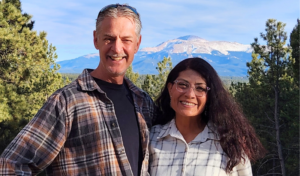
Her message is clear: Veteran lung cancer and biomarker testing are inseparable topics. Testing at diagnosis—not after recurrence—can change everything. Lung cancer is not a one-size-fits-all disease, and treatment options have evolved dramatically. Anyone with lungs can get lung cancer, and every person diagnosed deserves access to the most current science available. Michelle Alarid is living proof that when Veterans with lung cancer get the biomarker testing they deserve, hope doesn’t just exist—it endures.
I’m using my lungs to advocate
As a member of LCFA’s Speakers Bureau, I’m advocating for research and raising awareness through the media, embodying hope and action.
View Speaker Profile