

LIVING WITH SMALL CELL LUNG CANCER
A Rare Condition Worth Knowing About: LEMS and Small Cell Lung Cancer
If new weakness, fatigue, or other changes don’t add up, it may be more than a treatment side effect. Here’s what to know and what to ask your care team.
What Is LEMS?
Lambert-Eaton myasthenic syndrome, or LEMS, is a rare autoimmune condition that affects communication between nerves and muscles. In LEMS, the immune system mistakenly targets proteins that nerve cells use to signal muscles, which can lead to weakness and other changes in how the body functions.
LEMS can occur on its own, but it’s often what’s known as a paraneoplastic syndrome — a condition triggered by an underlying cancer, most commonly small cell lung cancer (SCLC). Because LEMS comes from the immune system rather than the tumor itself, its symptoms don’t always show up where you’d expect, and they aren’t caused by the tumor physically pressing on nerves.
For people living with SCLC, that connection matters. Understanding LEMS means knowing there’s a treatable explanation when something happens.
Why LEMS Matters for People with SCLC
LEMS symptoms can look a lot like the effects of chemotherapy or the cancer itself: feeling a little more tired than usual, or a little weaker. Without a specific reason to look closer, those changes are easy to attribute to treatment.
A 2025 study of real-world patient data found LEMS documented in only a small fraction of a large group of people with presumed SCLC. It was also diagnosed more than twice as often by neurologists as by oncologists. That gap suggests LEMS may be under-recognized within cancer care. That’s not because it’s impossible to catch, but because it isn’t always front of mind.
THE CONNECTION
50%+ of LEMS cases are associated with an underlying cancer - most commonly small cell lung cancer
About 6 -11 Months the typical time patients to receive a correct LEMS diagnosis
More than 1 in 3 people with LEMS who were misdiagnosed were first told they had myasthenia gravis
Why LEMS Is Often Missed
LEMS symptoms can look a lot like the effects of chemotherapy or the cancer itself — a little more tired than usual, a little weaker. Without a specific reason to look closer, those changes are easy to attribute to treatment.
A 2025 study of real-world patient data found LEMS documented in only a small fraction of a large group of people with presumed SCLC — and diagnosed more than twice as often by neurologists as by oncologists. That gap suggests LEMS may be under-recognized specifically within cancer care — not because it’s impossible to catch, but because it isn’t always front of mind.
- Symptoms overlap with treatment side effects
- Fatigue can mask true muscle weakness
- Awareness of LEMS is still limited among care teams
KNOW THE SIGNS
LEMS Fact Sheet-

MOBILITY
Muscle Weakness
Difficulty rising from a chair, climbing stairs, or walking - especially weakness in the hips and upper legs
-

AUTONOMIC SYMPTOMS
Dry Mouth & Constipation
Changes in saliva or digestion can be signs of LEMS's effect on the autonomic nervous system.
-

LESS COMMON
Eyelid & Vision Changes
Some people also notice drooping eyelids or changes in vision.
What to Ask Your Care Team

You don’t need to know the medical terms. You just need to describe what’s changed. Here are a few ways to start the conversation.
How LEMS Is Diagnosed and Managed
-

CARE TEAM COLLABORATION
Your Oncology Team
Continues to manage your SCLC treatment and can refer you for a neurological evaluation if symptoms suggest LEMS.
-
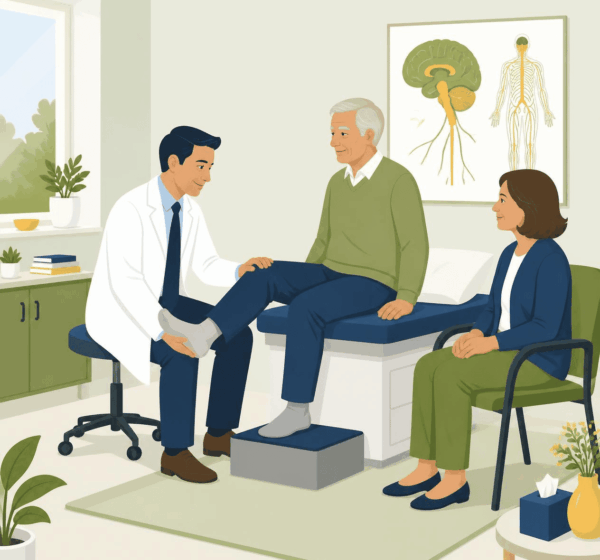
CARE TEAM COLLABORATION
A Neurologist
Confirms LEMS through VGCC antibody testing and/or electrodiagnostic testing, and manages symptom-directed treatment.
Get A Free Guide to Lambert-Eaton Myasthenic Syndrome (LEMS)
Get our printable LEMS Patient & Caregiver Guide