
About Lung Cancer | Treatments
Your Treatment, Your Time, Your Life Back
A faster, less invasive way to receive some lung cancer treatments. Learn how subcutaneous (SubQ) treatment delivery works.
What Is Subcutaneous (SubQ) Delivery?
When you receive cancer treatment, how it enters your body matters. Subcutaneous, or SubQ, delivery is one method doctors use to give certain medications.
SubQ means the medication is injected just under the skin, usually in the belly, thigh, or upper arm. It’s different from intravenous (IV) infusion, which delivers medication directly into a vein through a needle or port.
You may already be familiar with SubQ injections. Insulin for diabetes and some vaccines are given this way. Now, some cancer treatments—including certain immunotherapies—are available as SubQ injections.
Which Lung Cancer Treatments Use SubQ Delivery?
SubQ delivery is becoming more common for certain types of lung cancer treatment, including:
- Immunotherapy: Some immune checkpoint inhibitors now have FDA-approved SubQ formulations
- Supportive care medications: Drugs that help manage side effects or boost blood cell counts
Research is ongoing to develop SubQ versions of other cancer treatments. Clinical trials are also studying new SubQ formulations that may expand options in the future.
Ask your care team if a SubQ option is available for your prescribed therapy.
Why Subcutaneous Delivery Is Getting Attention?
Advances in drug formulation are allowing some cancer therapies to be delivered as subcutaneous injections under the skin instead of IV infusions.
For certain treatments, this approach may:
-
shorten clinic visits
-
reduce time spent in infusion centers
-
improve convenience for patients
Researchers continue to study when subcutaneous delivery can provide the same effectiveness as traditional IV therapy.
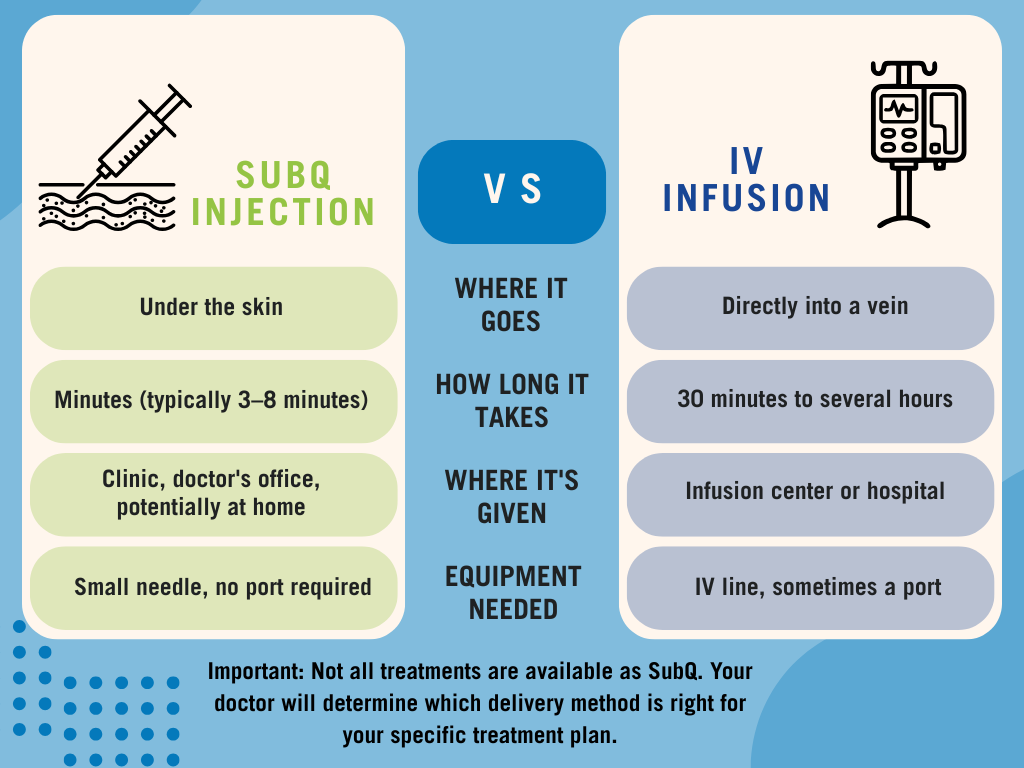
SubQ vs. IV Infusion—What’s the Difference?
| SubQ Injection | IV Infusion | |
| Where it goes | Under the skin | Directly into a vein |
| How long it takes | Minutes (typically 3–8 minutes) | 30 minutes to several hours |
| Where it’s given | Clinic, doctor’s office, potentially at home | Infusion center or hospital |
| Equipment needed | Small needle, no port required | IV line, sometimes a port |
Important: Not all treatments are available as SubQ. Your doctor will determine which delivery method is right for your specific treatment plan.
FAQs about SubQ
For eligible patients, SubQ delivery may offer:
- Shorter appointment times: Spend less time in the clinic and more time living your life
- No IV or port required: A simple injection under the skin—no need for IV access
- Fewer disruptions: Quicker visits can make treatment easier to fit into your schedule
- Potential for at-home treatment: Some SubQ treatments may eventually be given at home by a caregiver or trained professional
- Same effectiveness: The medication works the same way whether given by SubQ or IV—the difference is in delivery, not results
If your doctor prescribes a SubQ treatment, here’s what typically happens:
Preparation: A nurse or medical professional cleans the injection site (usually your belly or thigh)
Injection: The medication is injected just under the skin using a small needle—usually takes only a few minutes
Observation: You may be asked to stay briefly for monitoring, especially during your first few treatments
Most side effects are related to the medication itself, not the way it is delivered. This means that many common side effects, such as fatigue, rash, or immune-related effects, may occur whether the treatment is given by IV infusion or as a subcutaneous (SubQ) injection.
However, the type of reaction during treatment may differ depending on how the medication is delivered.
IV infusion may cause:
- infusion reactions such as chills, flushing, or fever during treatment
Subcutaneous (SubQ) injections may cause:
- mild redness, swelling, or tenderness at the injection site
Injection-site reactions are usually temporary and mild. Your care team will monitor you during treatment and help manage any side effects.
Questions to Ask Your Doctor
Considering SubQ delivery? Start the conversation with your care team:
- Is my current treatment available as a SubQ injection?
- Would SubQ delivery be as effective as IV for my type of lung cancer?
- Are there any reasons SubQ wouldn’t be right for me?
- How much time could I save with SubQ compared to IV infusion?
- Could I eventually receive SubQ treatment at home?
- Are there clinical trials studying SubQ options for my treatment?
Download the SubQ Conversation Toolkit
Take these tools with you to your next appointment.
✔ SubQ Treatment Delivery FAQ
✔ SubQ vs. IV Infographic
✔ Conversation Guide for Talking to Your Doctor
Fill out the form to receive your toolkit.
We respect your privacy. Your information will never be shared, and you can unsubscribe from our emails at any time.