
Understanding Clinical Trials
Clinical Trials: An Option to Consider Early
For people diagnosed with lung cancer, clinical trials may offer access to promising treatments in addition to standard care.
What is a clinical trial?
A clinical trial is a research program conducted with patients to determine if an investigational treatment, drug, or device is a better line of defense than the current “best standard of care.”
Clinical trials are taking place all over the world, evaluating the success of promising new treatments for lung cancer that are awaiting formal government approval. These research trials typically involve medications or strategies that have already been shown in earlier research to have promise. There are many different kinds of clinical research trials.
Clinical trials can include studies that:
- Evaluate which dose of a new medication is best
- Investigate whether an approved drug can or should be used in combination with other treatments
- Evaluate treatment for use in patients who haven’t had any treatment yet
- Evaluate treatment options for patients whose cancer has progressed after prior treatment
Clinical trials offer many potential benefits to an individual patient:
- You may get a new treatment for your specific lung cancer before it is available to everyone.
- Clinical trials allow you to play a more active role in your own health care.
- Clinical Trial providers may provide you with medical care and more frequent health check-ups as part of your treatment.
- You might be “paying it forward.” Helping others get better treatment for their health problems in the future.
Clinical trials are not a last resort. In many cases, they are considered before treatment begins, when more options may be available.
Free Clinical Trial Conversation Toolkit
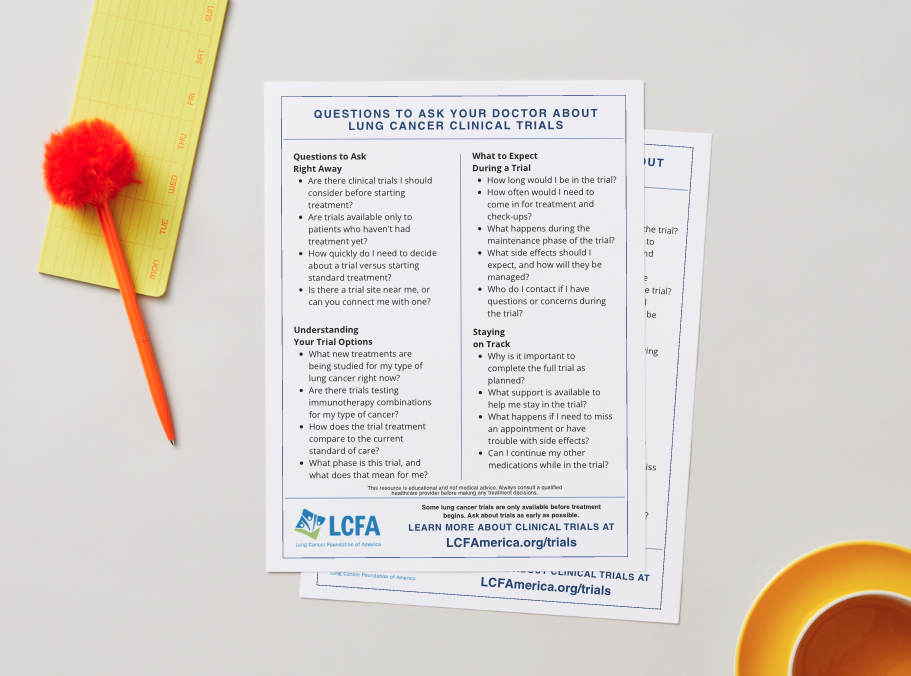
If you or a loved one is considering a clinical trial, this free toolkit can help you feel more prepared before talking with your care team.
These tools are educational and can be used alongside guidance from your healthcare team.
Why Clinical Trials Matter
Clinical trials play a critical role in improving lung cancer treatment. Many therapies available today became standard care because patients participated in research studies.
Clinical trials may provide:
- access to promising new therapies
- additional monitoring by research teams
- opportunities to contribute to advances in cancer care
While clinical trials offer potential benefits, they also involve uncertainties. Your care team can help you decide whether a trial is appropriate for your situation.
How Clinical Trials Work
Clinical trials follow strict guidelines to protect patient safety and privacy. Participants receive close monitoring, and studies are reviewed by independent oversight committees.
Key things to know about clinical trials:
- Clinical trials are voluntary
- Participants can leave a trial at any time
- Many trials compare standard treatment with a new approach
- Patient safety is continuously monitored
Before joining a study, participants go through an informed consent process, where the research team explains the purpose of the trial, the possible risks and benefits, and what participation involves.
-

The clinical trials give us that hope of longer progression-free survival, and the ability to share time with our families and the ones that we love. My experience has been, I've gotten two years additional time so far on the two different trials that I'm on, and I expect to continue to have more years to live life and enjoy those milestones that make life what you want. It makes it enjoyable. It makes it meaningful. And without the study therapy and the research, I wouldn't have that.
Wendy Brooks, living with SCLC
-

We are in about the most exciting age in lung cancer. It’s an age of rapid fire discovery. Every six months there is a new drug, just about. A new biomarker or a new drug. The best treatment is a clinical trial. What’s the purpose of research? I say, it’s the opportunity to give tomorrow’s treatment today. Especially when you’re in an age of rapid fire discovery.
Dr. Osarogiagbon, LCFA's Scientific Advisory Board
-

In some ways, going into a clinical trial insures you’re going to get the best possible cancer care.
Janet Freeman-Daily, Lung Cancer Patient/Advocate
-
That’s how any other drug was developed is through a clinical trial… all paths lead back to the clinical trial.
Montessa Lee, SCLC Survivor and Advocate
Common Questions About Clinical Trials
Many cancer clinical trials do not use a placebo-only approach. In many studies, participants receive either:
- Standard treatment, or
- Standard treatment plus an additional study treatment
If a placebo is used, the study team will explain exactly how it works and what treatment you would receive.
Yes. Clinical trials are designed so that participants receive appropriate medical care. Your study team will explain the treatment plan, including what is standard of care and what is investigational.
Yes. Participation is voluntary. You can stop participating at any time, for any reason. Your care team will discuss next steps so your treatment continues safely.
Clinical trials include multiple layers of safety monitoring, which may include:
- Frequent check-ins and lab work
- Clear rules for dose changes or stopping treatment
- Review by independent safety monitoring groups
- Oversight by ethics boards and regulators
You should always report new symptoms or side effects right away.
Informed consent is a process where the study team explains:
- The purpose of the trial
- The possible risks and benefits
- What visits and tests are required
- Your rights as a participant
You can ask questions at any time, and you can take time to decide.
Not necessarily. Many trials are designed so your regular oncologist remains involved while the trial team manages study-related care. Ask how your care will be coordinated.
Coverage varies by study, but often includes:
- Study medication (if investigational)
- Trial-specific tests and procedures
- Routine care costs may still be billed to insurance. Always ask for a clear cost review before enrolling.
It depends. Some trials require no prior treatment, while others are designed for people who have already received therapy. This is one reason it can help to ask about trials early.
You can ask for support from:
- Your oncologist
- A nurse navigator or social worker
- The clinical trial coordinator at the trial site
Bring a printed list of questions to make the conversation easier.
Clinical trial resources
Find a Clinical Trial for You-
Match to clinical trials in 60 seconds
Search for a Clinical Trial with Antidote Match™
Antidote Match™ connects people with medical research studies, in the fastest and easiest way possible. All you need to do is answer a few questions, and they will find the right trials for you. You gain access to the latest medical developments and world-class care
-
Lists up-to-date information
Search for a clinical trial at ClinicalTrials.gov
ClinicalTrials.gov is a database of privately and publicly funded clinical studies conducted around the world.